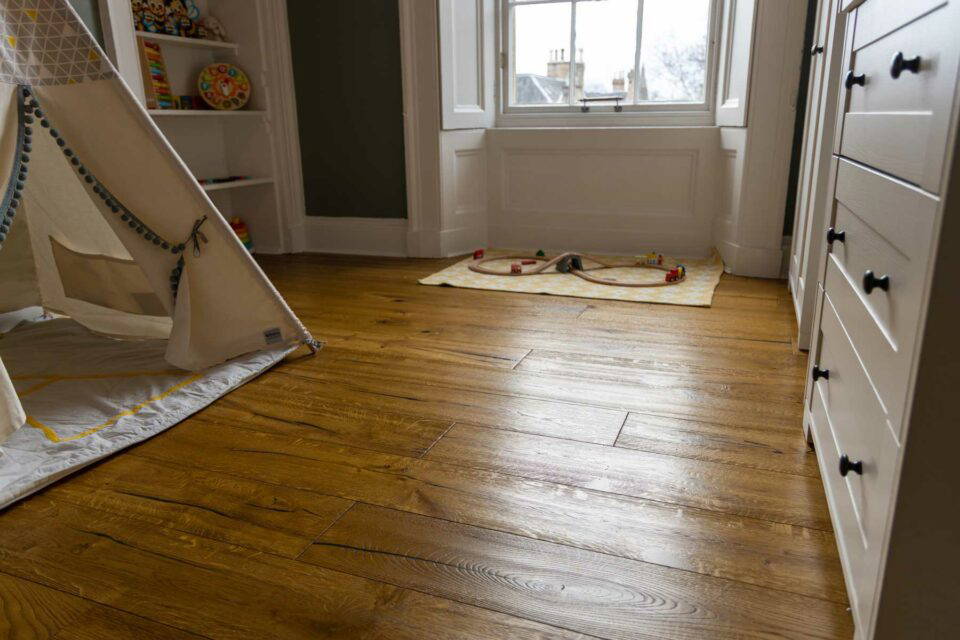
Here’s an uncomfortable truth from years of fitting floors: we see more engineered wood floors damaged by cleaning than by dogs, kids and furniture combined.
The scratches people worry about are cosmetic. The damage done by the wrong mop, the wrong spray or a well-meaning steam clean goes deeper and costs more.
The good news? Caring for a wood floor properly is easier — and cheaper — than caring for it wrongly. This is the aftercare talk we give every customer at handover, written down.
First, know your finish
Every engineered floor has one of two finishes, and the care routine depends on which.
A lacquered floor has a sealed protective coat sitting on top of the wood. Liquid can’t reach the timber and it wipes clean easily. But scratches show as white lines, and damage can’t be spot-repaired — fixing a lacquered floor properly means sanding and re-coating the room.
An oiled floor is protected by oil soaked into the grain. It looks and feels more natural, scratches show less, and worn patches can be spot-repaired invisibly. But it needs its oil topping up periodically.
Not sure which you have? Drip a little water somewhere discreet. If it beads and sits on the surface, you’re likely lacquered. If it slowly darkens the wood, it’s oiled. Wipe it up either way.
The weekly routine (it’s short)
- Vacuum or sweep first, always. Grit acts like sandpaper — walking it around does more damage than any spill. A vacuum with a hard-floor setting or a soft brush is all you need.
- Damp-mop, never wet-mop. The mop should feel barely moist — wrung out until it stops dripping, then wrung again. Standing water is the fastest way to swell joints and lift edges on any wood floor.
- Use a cleaner made for wood floors, matched to your finish — oiled-floor soap for oiled boards, lacquer cleaner for lacquered. Supermarket multi-surface sprays, vinegar and anything promising ‘shine’ leave residues, dull finishes or strip oils. One correct bottle lasts a year.
- Wipe spills when you see them. Not out of panic — just habit. Minutes are fine. Overnight is not.
The blacklist: things that ruin wood floors
Steam mops top the list, and we can’t say this strongly enough: never use a steam mop on a wood floor.
Steam forces hot moisture directly into joints and grain. It delaminates boards, clouds lacquer and voids essentially every manufacturer’s warranty. It doesn’t matter what the advert shows.
Alongside steam: bleach and ammonia cleaners, abrasive scourers, and polish or wax on lacquered floors — nothing sticks to a waxed floor afterwards, including the recoat it will eventually need. There is more on what ruins a floor fastest over in Help & Advice.
Prevention beats cleaning
The cheapest floor care doesn’t involve cleaning at all.
Felt pads under every chair and table leg prevent most of the scratches a floor ever receives. Check and replace them every few months, because they fall off.
A decent doormat at every external door catches the grit before it reaches the wood. Chair castors should be the soft-wheel type, or sit on a mat.
And in Scotland’s centrally heated winters, hairline seasonal gaps between boards are normal. They’ll close again come spring.
Oiled floors: how often should you re-oil?
An oiled floor’s protection gets walked off gradually, so it needs re-oiling — but far less often than people fear.
As a rule of thumb: high-traffic areas like hallways and kitchens every 1–2 years, living rooms every 2–4, bedrooms barely at all.
The tell-tale is how water behaves. When spills stop beading and start soaking in quickly, or traffic lanes look dry and pale, it’s time.
A maintenance oil applied to a clean floor takes an afternoon. Or we can do it for you and have the room back in service the next day.
Scratched anyway? Your options, minor to major
- Fine surface scratches on oiled floors: often disappear with a wipe of maintenance oil on a cloth. Try this before anything else.
- Deeper scratches: colour-matched retouch markers and hard-wax filler sticks make dents and gouges disappear from normal viewing distance. Decent kits are sold to the public too.
- A properly damaged board: engineered boards can be individually replaced by a fitter. Keep a spare pack from your installation in a cupboard — this is why we always suggest ordering one box more than the job needs.
- A tired floor overall: engineered wood with a decent wear layer can be fully sanded and refinished, coming back close to new for a fraction of the cost of replacement.
When to refinish, when to replace
If the damage is in the finish — dullness, scratches, traffic lanes, water marks — refinishing wins almost every time.
If the boards themselves are failing — delaminating layers, widespread swelling, movement coming from the subfloor below — replacement is the honest answer. Anyone quoting a sand-and-seal over a failing floor is selling you two jobs.
Not sure which side of the line your floor sits on? Send us photos. We’ll tell you straight — including when the right answer is the cheaper one.
Want your floor to last for decades?
Choosing the right product and looking after it properly makes all the difference to how long a floor lasts.
Whether we fitted your floor or someone else did, we’re happy to advise on care, supply the right products, or take on re-oiling and refinishing work across Edinburgh and the Lothians.
Call us on 0131 285 6435 or get in touch through the site.
Related questions
See our flooring installation service or get an estimate.
We install floors across Edinburgh, East Lothian, Midlothian and West Lothian.