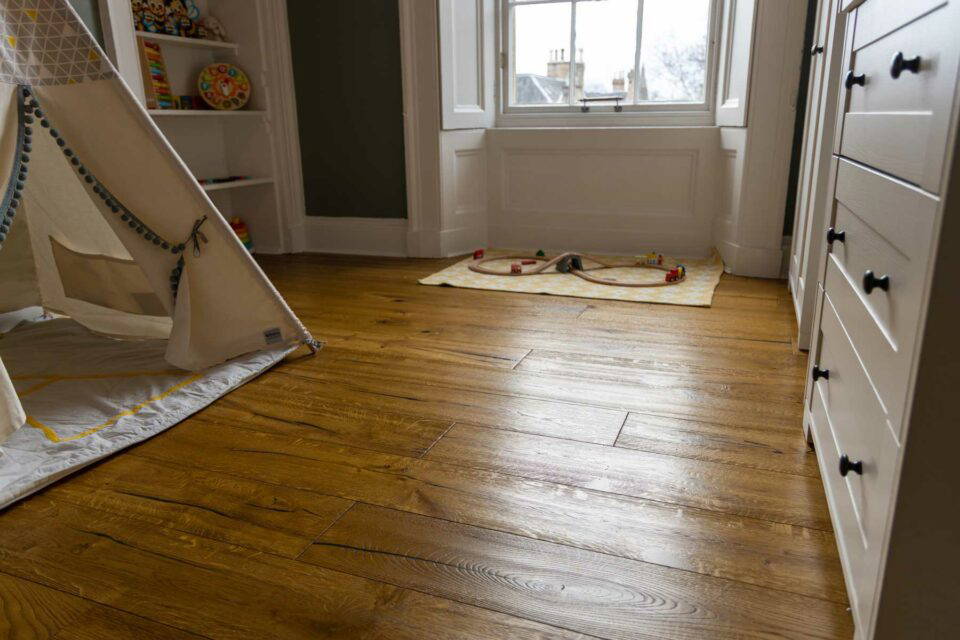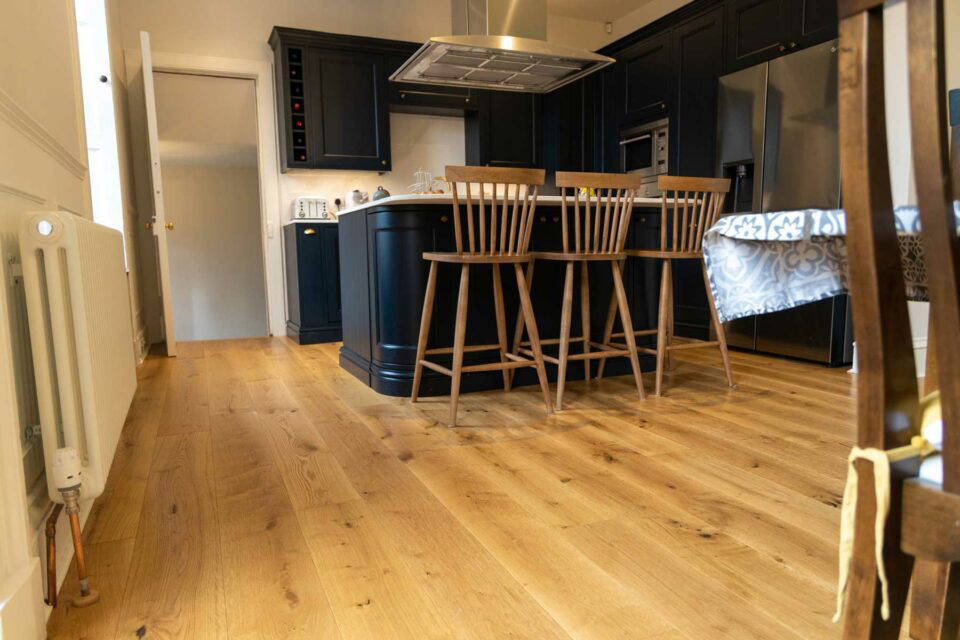
Floors here get a harder time than most, and it is not really about how much you walk on them. It is about what comes in on your feet, and that changes right through the year.
If you know what each season is throwing at your floor, you can stay ahead of it instead of dealing with it after the damage is done.
Why Edinburgh is hard on floors
Three things, mostly.
The grit. Sandstone dust off the buildings, grit and salt spread on the pavements from about November, and sand blown up off the coast if you are out east. All of it is harder than the lacquer or the wear layer on your floor.
The stair. If you are in a tenement, everything that comes into the close comes into your flat. You are not just carrying in what is on your own doormat, you are carrying in what fifteen other people walked through as well.
The weather. Wet boots for a good chunk of the year, then the heating going on hard from October and drying everything out. Timber floors feel both of those.
Autumn, September to November
This is the run up. What you do now decides how bad the winter is.
Sort your matting before it gets wet. This is the single most useful thing on the list. You want a proper long mat, enough that somebody takes two or three steps on it, not a wee square that they clear in one stride. In a tenement it goes inside your own front door, because the close is where the grit is.
Have somewhere for boots. A tray or a mat right at the door. Wet boots left standing on a timber or laminate floor will mark it, and a puddle sitting at a joint overnight is how you get a swollen edge.
Check your felt pads. Everything that moves, chairs especially. A worn pad picks up a bit of grit and turns into a cutting tool. It is a five minute job and it saves a lot of fine scratching.
Watch the humidity when the heating goes on. Timber shrinks as the air dries out, and you may see small gaps open up between boards. That is normal and they usually close up again in the spring. If it is severe, that is worth a conversation.
Winter, December to February
This is the worst of it, no question. Salt and grit on every pavement, and all of it coming in on your soles.
Dry dust more often than you think. Two or three times a week minimum in the winter, more if you have got a busy house. Microfibre dust mop. You are trying to get that grit up before it gets ground in, because once it is down in the grain and the bevels a mop is not lifting it out.
Deal with salt marks properly. Road salt leaves a white, chalky mark and it will dull a finish if you leave it sitting. Damp cloth with a pH neutral cleaner, straight away, do not let it dry on.
Keep the wet down. Boots off at the door, wipe up what comes in. It is the sitting water that does the damage, not the walking.
Do not be tempted by the steam mop. People get one out in the winter when the floor looks its worst. Heat and moisture forced into a joint is about the most damaging thing you can do to a floating floor.
By the end of the winter almost every floor in this city looks tired. That is normal, and it is mostly fixable.
Spring, March to May
This is the catch up, and it is the best time of year to get a floor properly seen to.
Book the deep clean now. A winter’s worth of grit and salt is sitting down in the texture of your floor and no amount of mopping is getting it out. This is exactly what the machine is for. There is more on why in our piece on mopping versus professional deep cleaning.
Expect dust. Spring is when the windows go open, when the roadworks start, and when there is sandstone dust about. Keep dry dusting.
Move your rugs. Shift them a foot or so, or lift them for a bit. Timber changes colour with light, and a rug left in exactly the same spot for years leaves you with a pale rectangle when you eventually move it.
Have a look at your finish. If you have got an oiled floor this is a sensible point to check whether it wants a refresher. Lacquered floors do not need this.
Summer, June to August
The easy months, but there are still a couple of things.
Sun. Long light evenings up here, and direct sun will fade a timber floor over a season. Blinds or curtains during the day in the worst-hit room, and keep moving those rugs.
Garden dirt. Back door going all day, soil and grass coming in. A mat at the back door as well as the front.
Festival, if you let your flat. If your place goes out on a short let in August, that is more traffic through it in four weeks than the rest of the year put together, and mostly with suitcases. Matting, and get it cleaned after. Same thinking applies to any rental, which we go into in keeping hard floors lettable between tenancies.
The bits that do not change
Whatever the season, this is the routine.
- Dry dust two or three times a week. More in winter, more if you have got a dog.
- Damp mop weekly with a pH neutral cleaner. Well wrung out. If you can see wet behind you, that is too much water.
- Wipe spills when they happen, not later, and especially at joints.
- Nothing with a gloss agent, polish or shine restorer in it. It builds up, it goes patchy, and then it is a job to get off.
- Keep an eye behind the appliances. A dishwasher or washing machine leaking quietly is the fastest way there is to ruin a floor.
When to book the professional clean
Roughly, the professional clean wants doing on this sort of cycle.
- Normal house, normal traffic: once every 12 months. Spring is ideal.
- Busy family house, kids, dogs, back door going all day: every 6 months. Spring and autumn works well.
- Commercial, retail, hospitality, HMO: every 3 to 6 months.
The signs it is due are dull patches, grey lanes down the hall, grit you can feel underfoot, a slightly tacky finish, or a floor that just never looks clean after you have cleaned it.
One more thing worth knowing. Most flooring manufacturers want evidence of correct maintenance to keep a wear layer warranty valid, so it is worth keeping a note of when it was last done.
Common questions
When is the best time of year to get floors deep cleaned?
Spring, for most people. You are taking off a winter’s worth of grit and salt in one go. If you are only doing it once a year, do it then.
Should I do anything different in a tenement flat?
Matting inside your own door rather than relying on anything in the close, and dry dust more often. You are dealing with everybody else’s grit as well as your own.
Gaps have opened between my boards over the winter. Is that a problem?
Usually not. Timber shrinks when the heating dries the air out and it generally closes back up in the spring. If the gaps are wide, or boards are cupping or lifting, get it looked at.
Is it worth doing before Christmas rather than after?
If you are having people in, yes, a floor looks its best straight after. But for protecting the floor, after the winter is when it is doing the most good.
Related questions
If your floors have had a hard winter, or you want a straight answer on what they actually need and how often, tell us about them. Get a free quote or give us a ring on 0131 285 6435.
We look after floors across Edinburgh, East Lothian, Midlothian and West Lothian.