A huge share of our work happens three storeys up a stone stairwell.
Edinburgh’s tenements are some of the best housing ever built in Britain — solid, generous, full of character. But they were built long before click-fit flooring, acoustic underlay or downstairs neighbours who work night shifts.
Fitting a new floor in a tenement is a different job from fitting the same floor in a modern house. It pays to know why before you order a single plank.
Here’s what we’ve learned from years of tenement work across the city.
What’s actually under your feet?
Lift a floorboard in a Victorian tenement and you won’t find concrete or chipboard. You’ll usually find the original timber boards nailed straight onto deep joists.
Between those joists, in many flats, there’s a layer of ‘deafening’ — ash, shells or similar material laid on boards to add mass and cut sound between flats. It’s a clever Victorian system, and where it survives intact it still works. Where it’s been removed during past renovations, flats get noticeably noisier.
This construction explains the two defining features of tenement floors: they slope, and they carry sound. Every decision that follows comes from those two facts.
Uneven floors: normal, but not something to ignore
A century of settlement means almost every tenement floor dips towards the middle of the building or rolls across the room. Mostly this is completely normal and structurally fine — Victorian buildings move, and they finished moving a long time ago.
But modern click-fit floors are made for flat surfaces. Lay laminate or LVT over a wavy subfloor and you’ll get bouncing joints, gaps, clicking noises and — with LVT especially — every ridge showing through the surface within months.
So the first step of a proper tenement job is levelling. Sometimes that’s overboarding with plywood, sometimes localised smoothing, occasionally packing boards where there’s too much movement.
It’s not the exciting part of the budget. But it’s the difference between a floor that looks fitted and a floor that just looks laid.
The neighbour question: sound matters more than style
Hard flooring carries impact noise — footsteps, chairs, dropped toys — far more than carpet. And in a tenement, your floor is someone else’s ceiling. Two things follow.
First, check your title deeds before you commit. Many Edinburgh tenement deeds have conditions about floor coverings — some require carpet or ‘suitable sound-deadening material’ in main rooms. Your factor or solicitor can confirm what applies. It’s far cheaper to find out now than after a neighbour dispute.
Second, whatever the deeds say, fit the floor properly anyway. That means a proper acoustic underlay rated for impact noise — not the thinnest foam in the shop. It means a fully floating floor with no fixings punching through the underlay. And it means an expansion gap at the walls so the floor never touches the skirting.
Sound travels through rigid connections. A well-fitted floating floor on the right underlay keeps the peace with the neighbours below. It’s a small line on the quote that buys years of goodwill.
Which floors actually work in tenements?
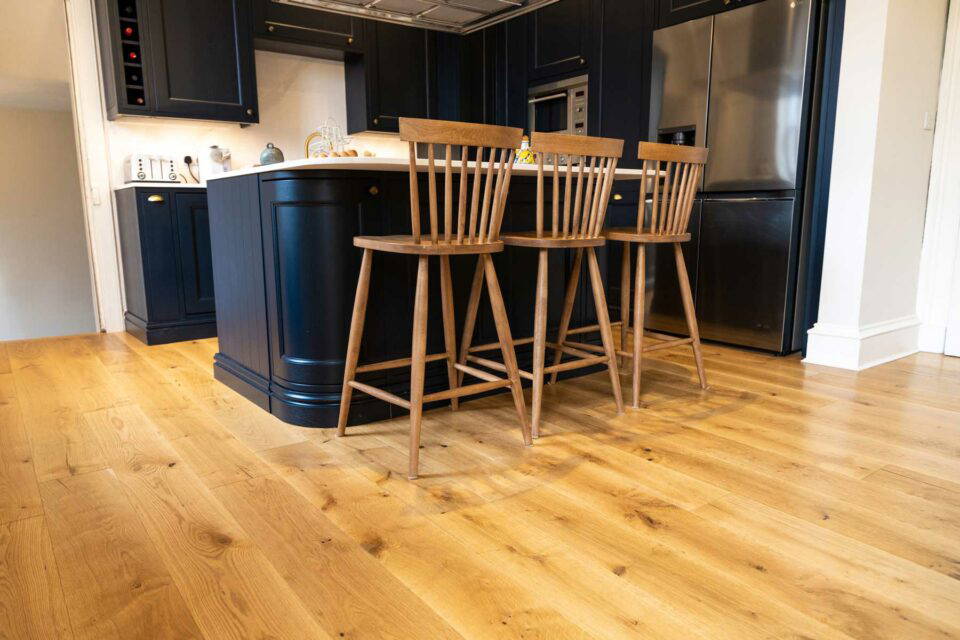
- Engineered wood: the natural fit for period rooms. Real timber that suits the proportions of a Victorian flat, stable enough for old buildings, and quiet underfoot on good acoustic underlay.
- Laminate: absolutely workable, with two conditions — a levelled subfloor and a serious acoustic underlay. Cheap underlay in a tenement is a false economy you’ll hear about from below.
- LVT: brilliant in tenement kitchens and bathrooms, but the most demanding of subfloor preparation. Budget for levelling, or don’t budget for LVT.
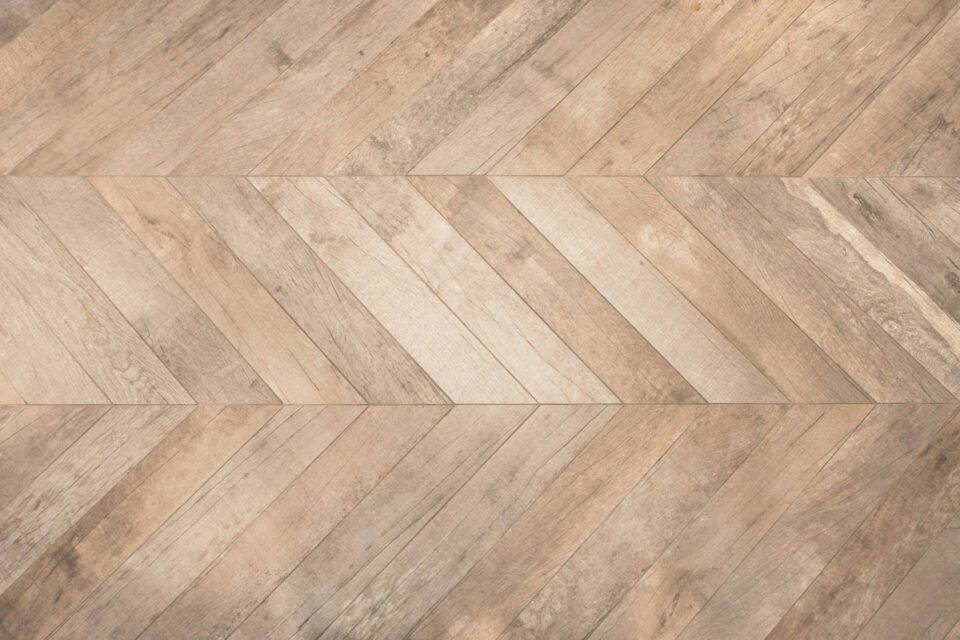
- Herringbone: tenement living rooms and hallways are where herringbone belongs. It was originally made for exactly these kinds of buildings, and it’s still the most requested look in our period projects.
Restore the original boards, or cover them?
Sometimes the best floor in the flat is the one already there. Original pine boards can be repaired, sanded and finished beautifully — and there’s something special about walking on the same timber as a hundred years of previous residents.
But be honest about the trade-offs. Sanded original boards are the noisiest option of all, because gaps between boards leak sound and draughts. Badly gapped or patched floors can cost as much to restore as to cover. And boards cut about by decades of pipework rarely sand up well.
Our usual advice: restore originals in bedrooms and quieter rooms where character matters most, and fit new engineered or LVT floors in the hardworking spaces.
And no — not every Victorian flat needs a full rip-out. More often than you’d think, the smarter renovation keeps what’s good and levels over what isn’t.
Draughts, access and the practical stuff
Two tenement bonuses worth knowing about.
First, draughts. A surprising amount of cold air comes into period flats through gaps in floorboards and under skirtings. A new floating floor over a quality underlay noticeably warms a room — customers mention it every winter.
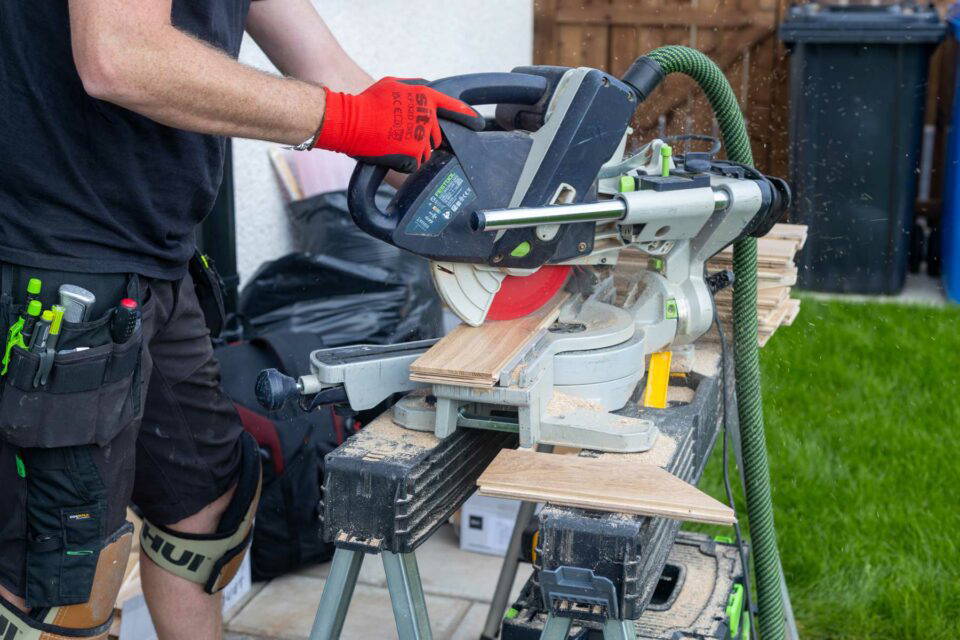
Second, access. Materials come up the stair by hand, so we plan deliveries and cutting carefully. We do as much cutting indoors as we can to keep noise down in the close, and we always let the neighbours know how long we’ll be.
It’s their building too. In a tenement, a bit of consideration goes a long way.
Thinking about a new floor in your tenement flat?
We’ve fitted floors in tenements across Edinburgh — from Marchmont herringbone to Leith kitchen LVT. We’re happy to talk through what your building, your deeds and your downstairs neighbour will thank you for.
Send us a photo and your room sizes for a free, no-obligation quote, or call us on 0131 285 6435.
Related questions
See our flooring installation service or get an estimate.
We install floors across Edinburgh, East Lothian, Midlothian and West Lothian.