If you’ve spent any time on Instagram or TikTok lately, you’ll have seen it: a fitter tapping oak blocks into a zigzag pattern, sped up, strangely satisfying to watch.
Herringbone installation videos rack up tens of millions of views — one recently passed 40 million. And every one of them sends another wave of enquiries our way. It’s comfortably the most requested floor in our Edinburgh projects, and has been for a few years running.
So is it just a trend? Should you follow it? And what should you know before spending herringbone money? Here’s our honest take, from the people actually laying it.
Why has herringbone taken over?
The funny thing about the herringbone ‘trend’ is that it’s over four hundred years old. Parquet patterns floored the grand houses of Europe centuries before Instagram, and Edinburgh’s finest period properties have worn them for generations.
What social media did was remind everyone how good it looks. Modern manufacturing did the rest — bringing the pattern into engineered wood, laminate and LVT at prices ordinary renovations can reach.
There’s a practical reason it photographs so well, and it’s the same reason it works in real rooms: the pattern adds movement and structure. A plain plank floor is a backdrop. A herringbone floor is a feature. In the high-ceilinged living rooms and long hallways of Edinburgh flats, it’s hard to beat.
Herringbone or chevron — what’s the difference?
People use the names interchangeably, but they’re different patterns.
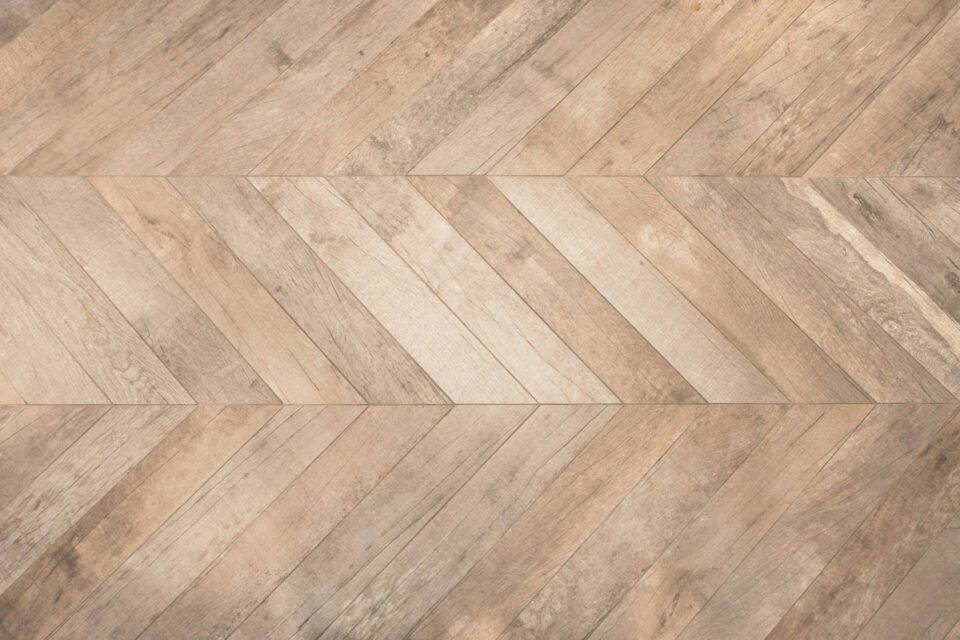
Herringbone uses rectangular blocks laid at 90 degrees to each other, creating a staggered zigzag — the classic look. Chevron blocks are cut at an angle (usually 45 degrees) so they meet in a continuous point, forming clean arrows down the room.
Chevron looks more modern and directional. Herringbone looks more traditional and textured. Chevron also tends to cost more to fit, because the angled cuts leave less room for error.
Neither is better. In a Victorian tenement we’d usually lean towards herringbone. In a sleek new-build kitchen extension, chevron can look superb. Send us a photo of the room and we’ll tell you which we’d fit.
Your three routes into the pattern
- Engineered wood herringbone: the real thing — genuine oak blocks with all the depth, grain and feel that made the pattern famous. The most expensive route and the most beautiful. This is what we fit in forever homes, and the option that adds the most value.
- Laminate herringbone: the budget-friendly surprise. Modern herringbone laminates are very convincing at normal viewing distance, extremely hard-wearing, and dramatically cheaper. Some boards come with the pattern pre-set, which keeps fitting costs down too.
- LVT herringbone: the practical choice for kitchens, bathrooms and busy family spaces. Fully waterproof, warm underfoot, and available in every tone from pale oak to smoked walnut. It demands a perfectly level subfloor, so budget for preparation.
What does it cost — and why?
Herringbone always costs more than the same material laid in straight planks. The honest reason is time and waste.
Every block is placed individually. Every row has to stay dead straight over the length of the room. Borders and thresholds need mitred detail work. And the diagonal cutting produces 10–15% wastage, against 5–7% for plank.
Depending on material, expect the fitting premium to run from around £5–£12 per m² for laminate herringbone, up to £60 per m² for bespoke wood or LVT pattern work — on top of the materials.
Our advice: if the budget is tight, a herringbone laminate in the hallway makes a bigger impression than plank oak, for less money. And if you’re saving for the real thing, save. A quality engineered herringbone is a floor you’ll never replace by choice.
Does block size matter? Yes — here’s how
This is one of our most-asked questions, and the answer is mostly about proportion.
Smaller blocks (around 70–100mm wide) create a busier, more traditional pattern that suits period rooms and smaller spaces. Larger blocks (120–150mm) create a calmer, more contemporary look and suit bigger, open rooms — but in a small bedroom they can overwhelm the space.
Direction matters too. Running the pattern towards the window, or down the length of a hallway, draws the eye and stretches the space.
The mistakes we get called in to fix
- Starting from the wrong line. Herringbone must be set out from a precise centre line. Start from a wall — which is never straight, especially in Edinburgh — and the pattern drifts visibly across the room.
- Skipping subfloor prep. The pattern multiplies the number of joints in the floor, and every joint shows unevenness. Level first, always.
- No border in rooms that need one. A simple single- or double-block border frames the pattern and solves awkward junctions at doorways and hearths. It’s a small detail that makes a big difference.
- Mixing batches without shuffling. Natural wood varies between packs, so blocks need mixing across boxes as you lay — or you get patchy shading.
Is it going out of fashion?
The honest answer: the social media frenzy will cool, because everything on social media cools. The pattern won’t.
A floor design that has survived four centuries isn’t going to be embarrassed by a trend cycle. If you love it, fit it — herringbone is about as close to timeless as flooring gets.
What does date a floor is colour. If longevity matters, choose a natural mid-oak tone over this year’s fashionable grey or ultra-pale blond.
Thinking about herringbone?
Have a look at the herringbone projects on our Projects page — including full Victorian flat transformations. Then send us your room sizes and a couple of photos.
We’ll tell you honestly which material and block size suit your space, and give you a free, no-obligation quote. Call 0131 285 6435 or use the quote form on this site.
Related questions
See our flooring installation service or get an estimate.
We install floors across Edinburgh, East Lothian, Midlothian and West Lothian.